
News Post
COD News
04/26/2026 | Academics
How a Career-Ending Injury Launched Amy Wasko's Next Mission
By Angela Mennecke
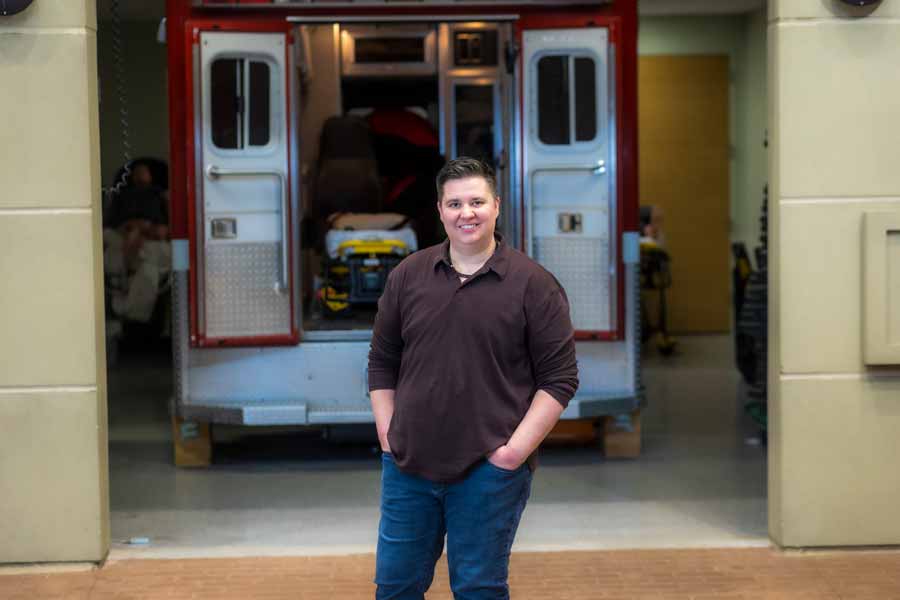
For nearly three decades, Amy Wasko ran toward the things most people run from — burning buildings, medical emergencies, the worst moments of strangers' lives. As a firefighter and paramedic, it was her calling. Then, slowly, the job she loved began to take its toll.
The list of injuries accumulated over time: spinal fusion, neck fusion, knee surgery, a rebuilt left shoulder, bicep surgery and lingering damage to her lower spine.
"My body was telling me, 'Hey, I've had enough,'" Wasko said.
It could have been the end of a story. Instead, it became the beginning of a new one.
Wasko, COD's 2025-2026 Collegewide Outstanding Adjunct Faculty Member and an instructor in the Fire Science program, was already teaching part-time at the College when her injuries forced her out of the field.
"Honestly, because of these injuries, it allowed me to come here and flourish," she said.
With the support of her former program manager, Dan Krakora, Wasko helped launch the Differential Medical Assessment program, redeveloped a trauma course and is currently working with Fire Science Professor Joe Gillis to rebuild the paramedic transition course. She holds a Level II EMS instructor certification — the highest level of EMS instruction offered nationally — and has completed all coursework for an Associate in Applied Science degree in EMS at COD.
Now she brings 30 years of hard-earned experience into the classroom, including her own injuries, which she uses as a teaching tool.
"Don't end up like me," she tells her students. "Take care of your bodies."
Walk into Wasko's class and you notice something that goes beyond lesson plans. She describes her classroom as family-oriented, and she works deliberately to make it feel that way.
Each semester, she meets individually with every student she teaches. Last semester, she sat down with just under 60 students in less than 24 hours.
"How are you doing? How are you doing in my class? What can I do to help?" she said. "Sometimes they want to talk about interviews or study habits. Others just want to talk. And I don't cut them off early."
She makes a point to seek out the quiet ones because, she said, those are often the ones with the most to share.
This personal investment, Wasko believes, is directly connected to something she has watched happen in real time: Fire science enrollment at COD is up approximately 25% semester over semester, and the four courses she teaches have seen consistent growth.
When Wasko talks about what she wishes more people understood about this profession, she starts with sacrifice.
You call 911 and somebody shows up every time. Those people are taking time away from their own families to help someone they've never met on probably the worst day of their life.Amy Wasko
But the sacrifice she speaks about most urgently is less visible: the mental cost of the work. It is something she has seen up close, and something she now weaves deliberately into her teaching.
Her battalion chief died by suicide — she had cooked him his last dinner. A fire chief from a neighboring department also died by suicide. A former COD student, a young woman working at a local fire department, took her own life.
The culture around mental health in the fire service has shifted significantly since Wasko started, she noted. Chiefs and administrators are talking about it openly.
Wasko is direct with her students about this reality. If they are struggling or ever experiencing what she calls "those dark thoughts," she wants them to reach out immediately. The phrase she hears most often now is one she believes in: It's OK to not be OK.
"This is a huge change from 30 years ago," she said. "Back then, you weren't talking about mental health at all."
On the last day of every course, Wasko leaves her students with the same three things: be nice, remember your origins and stay humble.
"As you get promoted, some people forget where they came from," she said. "In medicine especially, we have a tendency to eat our young. I don't want to see that happen."
She gives every student her cell phone number and email. Years later, former students still reach out. She watches them get married, start families and build careers.
For Wasko, that is what the work has always been about: showing up for people on their hardest days and being there for what comes after.
"I get to follow their journeys," she said. "That's one of the best parts of this."

COD News


© College of DuPage