
Radiography Program

Program
Program at a Glance
Degree Types
- Associate Degree
Formats
- In-Person
Length
- 6 Semesters | Associate Degree
Academic and Career Pathway
Picture Your Future
Master human anatomy and patient positioning to produce diagnostic x-ray images.
Interactive and hands-on DMIR courses will teach students various aspects of radiography including radiographic procedures, physics, radiographic equipment, radiographic image evaluation, basic pathophysiology, radiation safety, patient care and more.
Upon completion, students will earn an Associate of Applied Science degree and feel prepared to sit for the American Registry of Radiologic Technologist (ARRT) credentialing examination. In addition to the ARRT, students will be eligible to apply for state licensure which is a state of Illinois requirement as a condition of employment.
The Radiography program is approximately 24 months in length and begins in the summer semester. DMIR clinicals, classes and labs are held five days a week between the hours of 7:30 a.m. and 4:30 p.m.
Join us to learn more about the Radiography program. Additional sessions take place in November.Learn More About Radiography

Determine Your Path
Radiographers work in both clinical and hospital environments, primarily within diagnostic medical imaging (radiology) departments, but also in other areas such as emergency rooms, operating rooms, nurseries or patient rooms within a hospital.
Whether you are preparing for a career as a radiographer, planning to transfer to a four-year baccalaureate-granting institution or updating your skills, College of DuPage has the right program for you. We offer:
- Dedicated instructors with years of practical industry experience through clinical affiliates, certification and licensing.
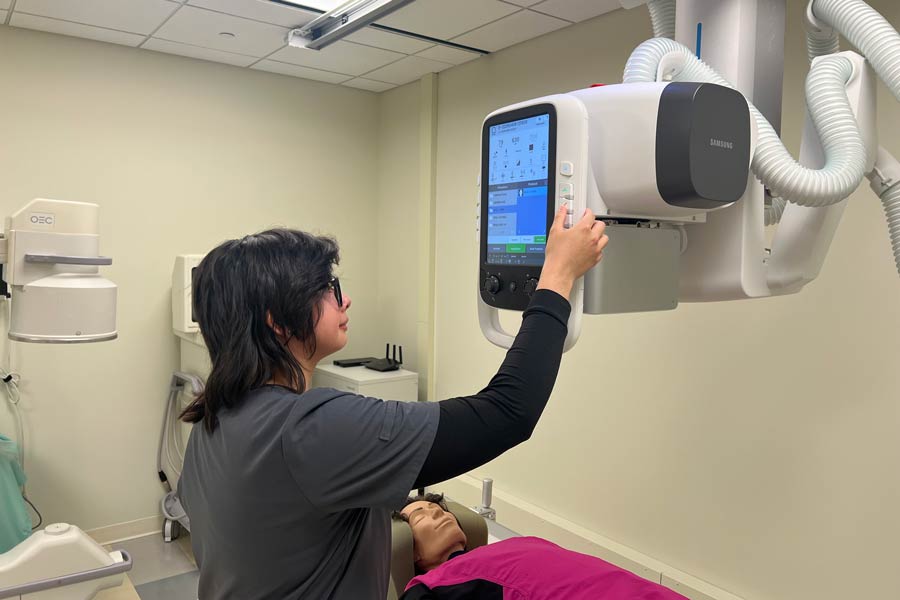
- Instruction using cutting-edge equipment including X-ray mannequins, a portable X-ray machine and C-arm.
- Affordable tuition that gets you on the fast track to success without breaking the bank.
- Program accreditation through the Joint Review Committee on Education in Radiologic Technology (JRCERT).
Diagnostic Medical Imaging Radiography, A.A.S.
The Radiologic Technology program (DMIR) in diagnostic medical radiography (X-ray technology) includes extensive clinical experience. Upon successful completion of the program, students are eligible for certification through the American Registry of Radiologic Technologists (ARRT); licensure is required for employment in the field in the state of Illinois through the Illinois Emergency Management Agency (IEMA). This program is accredited by the Joint Review Committee on Education in Radiologic Technology (JRCERT).
Students must achieve a grade of C or better in all program and general education requirements to earn an Associate of Applied Science (AAS) degree in DMIR.
Mammography, Certificate
The Mammography certificate at College of DuPage is a one semester, advanced certificate program that is designed to provide students with the necessary skills to become certified by the American Registry of Radiologic Technologists and meet the Mammography Quality Standards Act guidelines. This certificate requires seven credits in the courses listed below.
The following programs are advanced certificates that require the completion of the Radiography program.
The primary purpose of the Radiography program is to educate students with didactic, laboratory and clinical experience in preparation for the administration of ionizing radiation to humans for diagnostic purposes. Program policies and procedures are designed to meet or exceed those established by the Joint Committee on Education in Radiologic Technology (JRCERT).
Graduates will demonstrate competency to meet state licensure, and/or certification requirements defined by law for whole-body radiography, deliver compassionate patient-centered care to a diverse population, demonstrate strong critical thinking skills, and function as an integral member of a health care team with competence and confidence.
The radiography program is accredited by the Joint Review Committee on Education in Radiologic Technology
20 North Wacker Drive, Suite 2850
Chicago, IL 60606-3182
(312) 704-5300
Email: mail@jrcert.org
The Radiography program's current accreditation award is 8 years. General program accreditation information and the current accreditation award letter can be found by visiting www.jrcert.org.
Get Started Today
Enrollment in the Radiography program is by selected admission only. In order to apply, you must follow the specific admission criteria before being admitted into the program and follow the admission checklist located in the Radiography Application Packet. Acceptance into Radiography is based on a merit evaluation.
- Apply to College of DuPage
- Review the Radiography Application Packet.
- Have your transcripts sent to the College of DuPage Office of Student Records
- Attend a Radiography Exploration Session
- Run your degree evaluation
- Calculate your tentative merit evaluation score
- Meet with a Health Science Advisor
Priority for Admission
1. In-District applicants which includes:- In-District applicants who reside within Community College District 502
- Applicants who are part of the CAREER Consortium Agreement (meaning your residing community college does not offer the particular program in which you are applying)
- Applicants working full-time in-district (proof of in-district employment will be required each semester)
Students are expected to provide proof of a Comprehensive Health Insurance Plan prior to the start of the program or clinical start. The insurance plan must cover
you throughout the length of your clinical experience, which in most cases, consists of the entire length of the program. If you are in
need of Health Insurance, please note the following important dates and visit cod.studentbenefitplans.com. If you miss open enrollment, but have a qualifying life event, you can still apply
during a Special Enrollment Period. While we cannot guarantee your official acceptance into the program, you need to be aware that there
is short timeframe of when you are able to purchase a Health Insurance plan. The purpose
of this step is to make you aware and that the time to research and purchase is NOW. Purchasing health insurance outside of this timeframe will take months and may prohibit
your admittance into the Program. NOTE: Obtaining Health Insurance is NOT an application requirement but it is a requirement
to be in the program.Important Dates
If you will need health insurance ANYTIME within the next year, you must apply during
the current open enrollment period.
- Clinical Requirements Packet - Learn more about health requirements you may need to complete prior to registration or after program admission.
- Social Security Number (SSN) Requirements - While the College may not require an SSN for admission to all healthcare programs, students should be aware that the absence of an SSN may limit or prevent their ability to participate in certain clinical experiences, obtain required licensure or certification or secure employment upon graduation. Many healthcare employers, clinical education sites, licensing agencies and credentialing organizations require a valid SSN for employment, criminal background checks, payroll processing and/or professional licensure or certification. Students are strongly encouraged to verify SSN requirements with the applicable licensing board, certifying agency and prospective employers before enrolling in a healthcare program.
Goal 1: Demonstrate Clinical Competency
- Outcome 1: Students will position patients with accuracy.
- Outcome 2: Students will select appropriate technical factors.
- Outcome 3: Students will apply principles of radiation protection.
Goal 2: Demonstrate Critical Thinking Skills
- Outcome 1: Students will demonstrate competency in image evaluation.
- Outcome 2: Students will adapt to patient’s condition when performing non-routine procedures.
Goal 3: Demonstrate Professional and Ethical Behavior
- Outcome 1: Students will demonstrate professional behavior.
- Outcome 2: Students will demonstrate ethical behavior.
Goal 4: Communicate Effectively
- Outcome 1: Students will demonstrate written communication skills.
- Outcome 2: Students will demonstrate oral communication skills.
- Outcome 3: Students will effectively communicate in the health care environment.
Program Effectiveness
College of DuPage partners with several four-year institutions to help students seamlessly complete a bachelor’s degree in radiography. Students can connect with Transfer Services for personalized guidance on transfer opportunities.
For more information about Transfer Pathways, visit the College of DuPage Catalog. The pathway outlines a typical two-year course plan for completing an AA or AS degree before transferring to a four-year program. Course requirements vary by institution, so consult your faculty or academic advisor for specific guidance.
Articulation Agreements
College of DuPage maintains transfer agreements with many colleges and universities to ensure a smooth transition toward a bachelor’s degree. These agreements often include a defined course sequence. Students should regularly meet with a faculty member or Advising Services to stay on track.- Concordia University Chicago, AAS in Diagnostic Medical Imaging- Radiography to BA in Healthcare Management (3+1)
- Northern Illinois University, AAS in Diagnostic Medical Imaging- Radiography to BS in Health Sciences
Transfer Guides
Beyond articulation agreements and guaranteed admission programs, College of DuPage courses transfer to many other institutions. Transfer Guides help students select COD courses that meet prerequisites for specific majors and include details such as contact information, major requirements, general education requirements, and transfer policies.The Radiography program is graded on the following scale. Students must earn a final course grade of “C” (78%) or better in every DMIR course to continue in the program.
- 100-93% = A
- 92.9%-85% = B
- 84.9%-78% = C
- 77.9%-75% = D
- 74.9% and below = F
**Note: Grade percentages will not be rounded up to the next grade in any course.
In compliance with JRCERT Standard Five: Health and Safety Objective 5.5, the sponsoring institution and/or program have policies and procedures that safeguard the health and safety of students.
Purpose of Clinical Education
The purpose of clinical education is to allow the student to apply the theoretical principles of the didactic portion of the Program. Students may be required to rotate through alternate clinical education settings in order to achieve the goal of competency in a full range of radiologic procedures on children and adults. Students will not replace members of the affiliated clinical staff - they will have the status of learners. Students are not paid/compensated for clinical hours.
In order to meet the clinical requirements of the Program, students are required to complete clinical education in a Program-approved clinical education setting. The specific days that the students are required to be present at their clinical education setting are listed on the Clinical Education Calendar attached to each course syllabus. The student should be aware that these specific days might change at the discretion of the COD DMIR faculty to best meet the educational goals of the Program.
Clinical placement is considered permanent for the length of the program. When a student accepts admission into the program, they agree to the clinical site assigned at the time of admission into the program. Clinical site placement is not negotiable.
All students will participate in a clinical site orientation on the first day of clinical education in the 1stsemester. This clinical orientation will cover policies and procedures in regard to health and safety and will address at minimum the following: fire hazards, chemical hazards, emergency preparedness, medical emergencies, HIPAA, standard precautions, radiation protection & safety, and MRI safety. Upon completion of this orientation, students are required to complete the New Student Clinical Site Safety Orientation Verification form in Trajecsys, checking off each topic covered in orientation. The clinical instructor will verify each form with an electronic signature and date.
The clinical education settings are independent hospitals/medical centers, dedicated to education. The student must always maintain the safety, health, and ethical standards of the affiliate. Clinical education settings have the right to "deny access" immediately without notice and/or previous warnings if the student poses an immediate threat or danger.
Each clinical education setting has slight variations in procedures, policies, rules, dress codes, and security requirements. Therefore, students will be informed of the policies specific to their clinical education setting through an orientation process. The student must abide by the policy and procedures of their clinical education setting at all times. Visible body piercing outside of ear piercing is not allowed during clinical education training. Exceptions include body piercing as part of a religious or cultural obligation and/or traditions. Tattoos should be covered unless otherwise allowed by the clinical site. Refusal to comply may result in the students not being allowed to return to that affiliate. No guarantee is made for an additional clinical placement for noncompliance of program and/or clinical policies. For more information, refer to the Personal Appearance/Hygiene section of the DMIR Program Design.
Students are expected to display professional behavior at all times. While allowances will be made for new students, time and instruction will be given to the student to develop professionally. However, severe violations of professional conduct will not be tolerated. Students may be required to complete certain courses to help their professional development or be referred to counseling services. Students can be asked not to return to an affiliate for the severest types of unprofessional conduct and/or patient endangerment. No guarantee is made for an additional clinical placement under these circumstances or continuation in the Program.
Transportation
Students must provide their own transportation to and from the clinical education settings and may be required to travel to affiliated off-site facilities (geographically dispersed). Neither the of nor any of its affiliates accepts liability for the student during any travel to or from the clinical affiliates.
The clinical education portion of the Program was developed by the Clinical Instructors and the DMIR faculty and shall be uniformly applied in all of the Program clinical education settings. The policies were formed with consideration given to the JRCERT Standards, COD institutional policies, policies of the affiliates and student needs.
The Radiography program has partnered with the following clinics. Clinic sites are subject to change.
Central DuPage Hospital
25 N. Winfield Road
Winfield, IL 60190
Duly Health & Care
1801 S. Highland Ave, Ste 210
Lombard, IL 60148
430 Pennsylvania Ave, Ste. 110
Glen Ellyn, IL 60137
430 Warrenville Road
Lisle, IL 60532
Edward Hospital
801 S. Washington
Naperville, IL 60540
Elmhurst Memorial Hospital*
155 E. Brush Hill Road
Elmhurst, IL 60126
AMITA Health Adventist Medical Center, GlenOaks Hospital
701 Winthrop Avenue
Glendale Heights, IL 60139
Advocate Good Samaritan Hospital
3815 Highland Avenue
Downers Grove, IL 60515
Edward Hines Jr. Veterans Administration Hospital*
Fifth Avenue and Roosevelt Road
Hines, IL 60141
*Placement at Hines VA requires proof of U.S. citizenship by Federal Law.
AMITA Health LaGrange Memorial Hospital
5101 Willow Springs Road
La Grange, IL 60525
Presence Mercy Medical Center
1325 N. Highland Avenue
Aurora, IL 60506
Rush Copley Medical Center
2000 Ogden Ave.
Aurora, IL 60504
AMITA Health St. Alexius Medical Center
1555 N. Barrington Road
Hoffman Estates, IL 60194
Students wishing to appeal dismissal and/or other disciplinary actions, and/or issuance of academic grades issued by an Instructor and/or the Program must do so in writing within ten days of receiving the letter stating the action imposed.
- A will be submitted in Trajecsys generating an email to the student stating disciplinary action imposed.
- The student should obtain an appeal form from the Nursing and Health Science Division office (HSC 1220).
- An appeal board will be formed as soon as possible under the guidance of the Dean of Nursing and Health Sciences. If the semester is near the end, every effort will be made to conduct the hearing and render a decision.
- The student will be contacted to appear before the committee.
- The committee will hear the student’s appeal, consult with each other, and a decision will be rendered, and the student will be immediately notified by mail of the committee’s decision.
- The decision of the committee is considered final.
- Should a student have a grievance (complaint) related to the clinical education setting to which they are assigned, the student must document the grievance using the Clinical Site Incident Form in Trajecsys within five working days and meet with the Instructor of Record. It is the responsibility of the Instructor of Record to inform the DMIR Clinical Coordinator and/or Program Coordinator immediately of any potential grievance. Upon review of the grievance, the Instructor of Record may elect to involve the Dean of Nursing & Health Sciences.
- The “program” faculty will make every effort to resolve the student’s grievance at the program level and will notify the student in writing of any decision or action to be taken within 5 working days of the filing of the grievance.
- The student may elect to appeal any decision made by the Instructor of Record to the Program Coordinator and/or Dean of Nursing & Health Sciences but must do so within the time frame stated by the Nursing and Health Sciences Division. See Due Process policy.
- Discipline while officially enrolled as a COD student in the DMIR program are subject to all applicable policies and procedures of the clinical education setting to which the student is assigned.
- A student may only be dismissed (denied access) from the clinical education setting after all other appropriate disciplinary action has been taken in accordance with published policy and procedure and ONLY after consultation with the instructor of record and/or, Clinical Coordinator and/or Program Coordinator. However, a student may be denied access to the clinical education setting without consultation if they pose an immediate threat or danger. In such a case, the Instructor of Record and/or Clinical Coordinator and the Program Coordinator must be notified immediately if such action is taken.
Students have the right to submit allegations against a JRCERT-accredited program if there is reason to believe that the program has acted contrary to JRCERT accreditation standards. JRCERT expanded standards are posted on the JRCERT website and are available in Trajecsys under Documents.
Contact of the JRCERT should not be the first step in the formal institutional/program grievance procedure. The individual must first attempt to resolve the complaint directly with institution/program officials by following the grievance procedures provided by the institution/program. If the individual is unable to resolve the complaint with institution/program officials or believes that the concerns have not been properly addressed, he or she may submit allegations of non-compliance directly to:
JRCERT
20 N. Wacker Drive Suite 2850
Chicago, IL 60606-3182
Phone: (312) 704-5300
Fax: (312) 704-5304
Careers
Frequently Asked Questions
Find answers to your frequently asked questions regarding this program.
Radiology is the program for you if you enjoy working with people and have an interest in health care and technology.
You will also need to have excellent oral, written and interpersonal communication skills, good listening skills and hand dexterity and:
- Physical agility, the strength to assist and move non-ambulatory patients and the ability to stand for long periods of time.
- Emotional stability and good health.
- The ability to work independently and under stress.
- Fluency in conversational English.
Anatomy and Physiology is required for the Radiology program and must be completed by the end of spring semester for the year in which you are applying. Successful completion of DMIR 1100 Introduction to Diagnostic Medical Imaging Radiography with a grade of "B" or better prior to admission is also required.
Generally all previous college credit earned at an accredited institution acceptable to COD is transferable. The Office of Student Records evaluates transcripts to determine transferable credit.
Students educated outside the United States must request a course-by-course evaluation by Educational Credential Evaluators, Inc. (ECE), P.O. Box 17499, Milwaukee, WI, USA 53217. Credit transfer applications are available at the COD Office of Student Records.
Although the number of applicants varies, the program usually receives an average of 200 applications per year with an average of 50 applicants accepted.
Opportunities exist for experienced radiographers in advanced imaging modalities such as computed tomography (CT), magnetic resonance imaging (MRI), sonography (ultrasound), radiation therapy, nuclear medicine, mammography and interventional radiology. Sales and education are additional career options.
Inquiry Form
Interested in learning more about this program? Complete the form below and learn how to take the next step toward your goals.
Keeping pace with the latest technology, College of DuPage has installed three new
advanced radiographic systems to enhance its Radiography program. You must have a COD ID to meet with a Health Program Advisor.
Phone
Professor, Program Chair
Location
Phone
Email
Radiography Program in the News
Contact Information
Academic Plans
(630) 942-2259
Shelli Thacker
Health and Science Center (HSC), Room 2207R, (630)
(630) 942-2434
thacker@cod.edu

Take the Next Step
Whether you’re exploring, applying or planning your path, COD makes it easy to get started.
© College of DuPage